People usually arrive at this search in a moment of urgency. A family member hasn’t called, a legal situation is unclear, or an arrest has been mentioned but not confirmed. The first instinct is simple: type a name and expect a clear answer.
But Florida’s system doesn’t behave like a single public directory. What users see online is only a reflection of multiple custody layers, each updating at different speeds and under different rules. That gap between expectation and reality is exactly where most confusion begins.
Why Florida inmate information feels inconsistent
The biggest misunderstanding is assuming Florida operates one unified inmate database.
In reality, custody data is split between multiple independent systems:
- County jail systems handle recent arrests and short-term detention
- State correctional systems handle sentenced, long-term incarceration
- Court systems track legal proceedings that may not yet reflect custody changes
These systems do not sync instantly or perfectly. They operate on different administrative cycles, meaning a person can exist in one system and not appear in another at the same time. This is not a technical error it is how public custody administration is structured.
What actually happens after an arrest (real system flow)
When someone is arrested in Florida, the record does not immediately become a searchable “inmate profile.”
The process typically moves through stages:
First, the individual is taken into booking intake, where identity is verified, charges are recorded, and basic classification begins. During this stage, data is often incomplete or still being processed.
Next, the information is entered into the county jail management system. This is the first place where a public-facing record may appear, but even then, updates are not always immediate.
After that, classification decisions are made such as housing assignment, bond eligibility or transfer potential. Only after these steps does the record stabilize in a searchable form.
If the person is later sentenced, they are transferred into the Florida Department of Corrections system, where a completely new record structure is created and maintained separately. At each stage, visibility changes.
Why you sometimes cannot find someone even if they are in custody
One of the most common assumptions users make is that “no result means not in jail.”
In practice, there are several realistic reasons why a search returns nothing:
- A person may still be in the processing window, where intake is not complete enough for public indexing.
- The name may not match exactly due to alias usage, spelling variation, or missing identifiers such as middle names or suffixes.
- The person may be held in a county system that has delayed or batch-updated records, meaning data is temporarily invisible.
- Or they may have already been transferred between facilities, creating a gap where neither system shows them clearly.
These gaps are normal in custody data systems and are one of the most misunderstood parts of inmate searches.
How experienced users actually search inmate records
People who work with public records regularly do not rely on a single search attempt. Instead, they follow a layered verification approach.
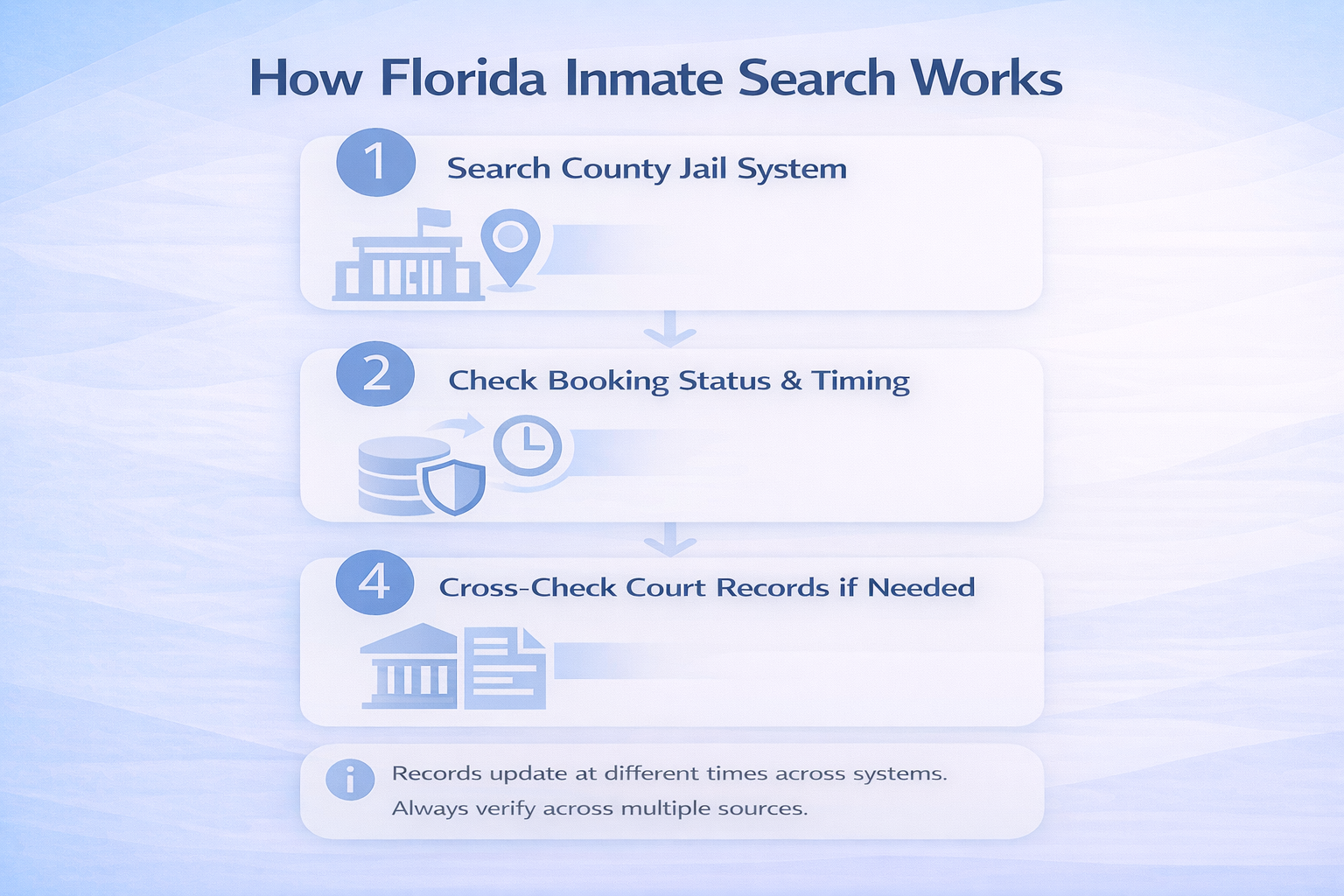
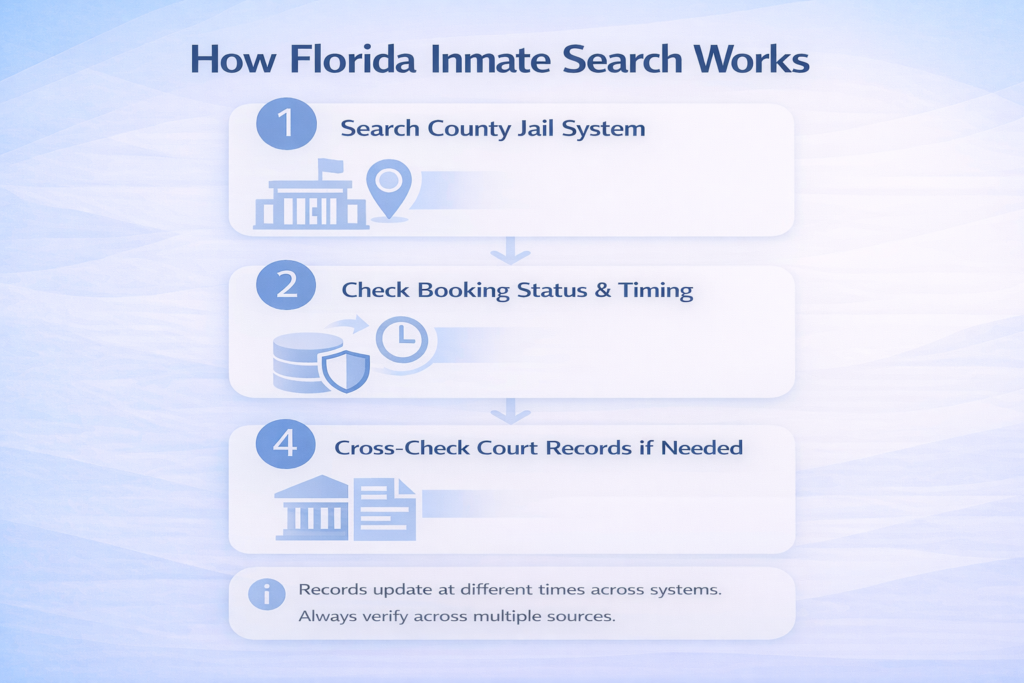
The first step is always identifying whether the situation is recent arrest or long-term custody. This determines which system is more likely to contain the record.
If the arrest is recent, the focus is on the county jail system, since that is where intake occurs. Each county maintains its own database, and those systems often reflect the most current custody status. If no result appears, the next step is to check the state correctional database, which only includes individuals who have been sentenced and transferred.
When both systems show nothing, experienced users shift away from inmate databases entirely and cross-check court dockets, because legal filings often appear before custody records fully update. This cross-system validation is what produces accurate results in real scenarios.
Why county-level differences matter more than people expect
Florida’s structure is decentralized. Each county jail operates independently, meaning there is no guaranteed standard for how quickly data updates or how detailed public records appear.
In larger counties, systems are often more modern and update frequently. In smaller counties, updates may be manual or delayed. This creates an uneven landscape where two identical arrests in different counties can appear online at very different times.
Understanding this variation is critical, because many failed searches are actually timing or jurisdiction issuesnot missing data.
Florida Counties Overview
Florida inmate records are managed at county level, and each system updates independently.
Major Metro Counties
Miami-Dade Broward Palm Beach Hillsborough Orange Pinellas DuvalCentral Florida Counties
Polk Volusia Brevard Osceola Seminole Lake ManateeSmaller & Rural Counties
Leon Alachua Sarasota Collier St. Johns Escambia Bay OkaloosaSystem Note
Florida has 67 counties. Each county operates its own jail system, so inmate updates do not sync instantly.
County jail searches are usually the most accurate for recent arrests (first 24–72 hours before state records appear).
The role of timing in inmate search accuracy
Timing is one of the most underestimated factors in public record systems. Even in well-managed counties, there is always a delay between:
- physical arrest
- booking completion
- system entry
- public visibility
Weekends, holidays, and high arrest volume periods can extend these delays further.
State-level systems typically update even more slowly because they depend on formal transfer and sentencing records, not immediate booking data. This is why inmate searches often feel inconsistent even when the system is functioning correctly.
Common mistakes that lead to wrong conclusions
A major error users make is relying on exact name matching. Booking data is not standardized like a legal identity database. Small variations can completely change search results.
Another common mistake is assuming “state database is complete.” It is not. It only reflects a specific custody category.
Users also tend to stop searching too early, without considering that records may appear later due to processing delays.
Finally, many people fail to cross-check court records, which often provide the earliest confirmation of legal status before custody data stabilizes.
Frequently asked questions
Why does someone show up in one county system but not another?
Because each county operates independently and does not share real-time updates.
How long does it take for arrest records to appear?
It can range from a few hours to more than a day depending on processing speed and workload.
Can someone be in jail without appearing online?
Yes, especially during intake or early processing stages.
Why does the state system show fewer people than county systems?
Because it only tracks sentenced individuals, not recent arrests.
Is there one complete Florida inmate database?
No. Records are distributed across county, state, and court systems.
Final understanding
Florida inmate search is not a single lookup system it is a layered public records environment where timing, jurisdiction, and classification all affect visibility. Once users understand that each system represents a different stage of custody rather than a complete record, the search process becomes far more predictable.
The most reliable approach is not relying on one database, but understanding how information moves between county intake, court processing, and state correctional records. That shift in understanding is what turns confusion into accuracy.