
Finding someone in jail in Ohio can feel more complicated than it should be. Most people expect a single statewide search tool, but that’s not how Ohio’s system works in practice. Inmate records are split between state prisons and individual county jails, each running its own database with different update speeds and search rules. Because of this, it’s very common for people to search in the wrong place and assume the person isn’t in custody at all.
In real situations, especially with recent arrests, timing also matters. A record may not appear immediately, even if the person has already been booked.
This guide is built to remove that confusion. Instead of sending you through multiple disconnected sources, it walks you through exactly how Ohio inmate search works, where you should look first depending on the situation, and how to find accurate custody details without wasting time.
Quick Ohio Inmate Search Tool
Enter a name below to begin your inmate search instantly. This tool helps you locate records quickly, while official systems can be used for final verification.
How to Perform Ohio Inmate Search (Step-by-Step)
If you approach inmate search randomly, you’ll often get no results even when the person is actually in custody. The key is knowing where to start based on the situation.
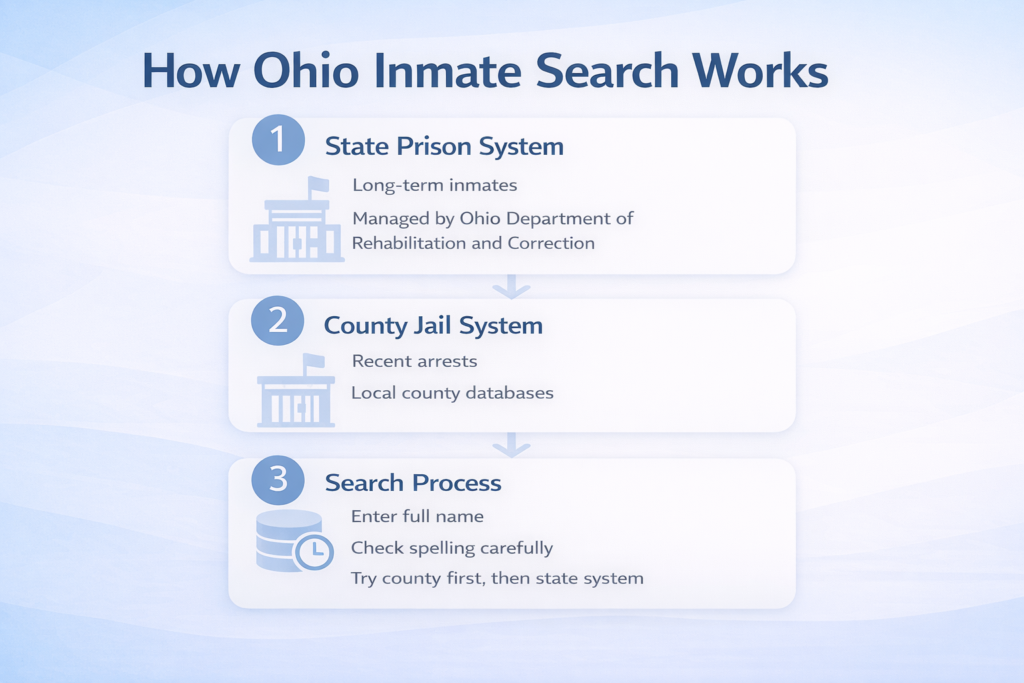
Start with the State System (Long-Term Inmates)
If the person has already been processed through the prison system, the most reliable place to begin is the database managed by the
Ohio Department of Rehabilitation and Correction
This system is designed for individuals serving longer sentences, not recent arrests. In practical terms, if someone was arrested within the last few days, you likely won’t find them here yet.
Move to County Jail Systems (Most Accurate for Recent Arrests)
This is where most people go wrong. In Ohio, newly arrested individuals are almost always held at the county level first, sometimes for days or weeks before any transfer happens. That means the fastest and most accurate results usually come from county jail websites not the state database.
Search Carefully (Name Accuracy Matters More Than You Think)
One small mistake in spelling can completely change your results.
In many Ohio systems, partial matches are limited. For example, searching “Jon” instead of “Jonathan” might return nothing. If results don’t appear, try full names, middle initials or slight variations.
Expect Delays (This is Normal, Not an Error)
Based on how different county systems operate, it’s very common for records to appear several hours after booking, and in some smaller counties, even longer.
This doesn’t mean the system is broken it simply reflects how data is processed internally.
👉 🔗 Access Official Inmate Search System
(Always rely on official government sources for the most accurate information)
When to Use State vs County Jail Search
In Ohio, knowing where to search is just as important as how to search. Many people don’t find results simply because they are using the wrong system.
If the person was recently arrested, the information is usually not yet transferred to the state-level database. In these situations, the county jail where the arrest happened is the most accurate and up-to-date source.
On the other hand, if the individual has already been sentenced and moved into the correctional system, the state database becomes the primary place to check. Understanding this difference helps avoid missed results and saves time when navigating multiple databases.
What Information You Can Actually Find
When you locate the correct record, Ohio inmate databases usually provide more than just a name.
You can expect to see identifying and custody-related details such as the inmate’s full legal name, booking date, charges filed, and the facility where they are being held. In many counties, bond information is also listed, which helps you understand whether release is possible and under what conditions.
Some systems go further and include housing location inside the jail, scheduled court references, or projected release dates. However, it’s important to understand that not every county provides the same level of detail. Larger counties tend to have more advanced systems, while smaller ones may show only basic information.
Common Issues During Ohio Inmate Search
Many search failures are not technical problems they’re simply misunderstandings of how the system works.
One of the most frequent issues is when a name doesn’t appear at all. In most cases, this happens because the search is being done in the wrong system. For example, checking the state database for someone who was just arrested will almost always return no results.
Another common situation involves timing. People often expect inmate records to appear instantly, but in reality, there is always some delay between arrest, booking and database updates.
You may also run into cases where multiple results appear for the same name. This is especially common with common surnames, and the only reliable way to identify the correct person is by cross-checking booking dates or location details.
Understanding How the Ohio Jail System Works
Ohio does not operate under a single centralized jail system. Instead, custody records are managed at two different levels: county jails and state correctional facilities.
County jails handle short-term detention, which includes recent arrests, individuals awaiting trial, or those serving shorter sentences. These systems are controlled locally, meaning each county maintains its own database and update schedule.
State prisons, on the other hand, manage long-term incarceration. Once a case is processed through the court system and sentencing is completed, inmates may be transferred to state facilities.
Because of this structure, inmate information is naturally spread across multiple systems. This is why searches often require checking more than one database depending on the situation.
Where Most People Make Mistakes
This is the part that makes the biggest difference.
After working through how Ohio inmate systems behave across different counties, a few consistent mistakes stand out mistakes that cause most searches to fail even when the information is available.
The first is relying only on the state system. Many users assume it covers everyone, when in reality it only includes those already processed into the prison system. If you don’t check county jail databases, you’re likely missing the most up-to-date information.
The second is expecting instant visibility after an arrest. In practice, there’s always a processing window. Even in well-maintained systems, updates are not always immediate.
Another overlooked issue is search accuracy. Small spelling differences, missing middle names, or incomplete entries can prevent results from appearing entirely. This makes it important to approach searches flexibly rather than assuming the first attempt will work. Understanding these patterns saves time and avoids the frustration most users experience.
Ohio Inmate Search by County (How the System Actually Works)
Ohio does not operate on a single unified jail database, which is why county-level searches are so important. In fact, if someone was recently arrested, there is a high chance their record exists only within a county system at that moment.
Ohio Counties Overview
A structured breakdown of Ohio counties to help you navigate inmate search more efficiently.
Major Metro Counties
Franklin Cuyahoga Hamilton Summit Montgomery Lucas ButlerUrban & Suburban Counties
Lorain Stark Mahoning Medina Lake Warren ClermontRural Counties
Adams Vinton Noble Monroe Meigs Hocking Gallia PerrySystem Note
Ohio has 88 counties. Each county manages its own jail system, so updates may vary.
County-level searches are usually more accurate for recent arrests within the first 24–72 hours.
Some of the most commonly searched county systems include:
🔹 Cuyahoga County Inmate Search
This county covers Cleveland and tends to have a well-maintained and frequently updated system, making it one of the more reliable sources for recent bookings.
🔹 Franklin County Jail Lookup
Serving the Columbus area, this system is often updated quickly and is commonly used for verifying recent arrests.
🔹 Hamilton County Inmate Search
For the Cincinnati region, this database provides booking details along with charge and bond information.
🔹 Summit County Jail Roster
Covers Akron and surrounding areas, offering current custody status and inmate listings.
🔹 Montgomery County Jail Search
Includes Dayton area records and typically provides booking and housing information.
Contact, Visitation & Sending Money (What to Expect)
Once you locate an inmate, the next step is usually communication or support.
Most Ohio facilities allow contact through scheduled visitation, phone systems, or approved messaging platforms. However, the exact process varies from county to county, and rules can differ significantly depending on the facility.
For example, some jails require advance scheduling for visits, while others operate on fixed time slots. Similarly, sending money may involve third-party services or on-site kiosks.
Because of these variations, it’s always best to follow the instructions provided on the specific facility’s official website after confirming the inmate’s location.
❓ FAQs – Ohio Inmate Search
How do I find an inmate in Ohio?
The most effective approach is to start with the state system for long-term inmates and then check county jail databases for recent arrests.
Is inmate information public in Ohio?
Yes, most inmate records are publicly accessible through official government systems.
How often is inmate data updated?
Update frequency varies. Some counties update records multiple times a day, while others may take longer depending on internal processes.
Can I check an inmate’s release date?
In many cases, yes. However, release dates are subject to change based on legal and administrative factors.
Conclusion
Finding accurate inmate information in Ohio comes down to using the right system at the right time.If you start with a clear understanding of how state and county systems differ, the process becomes much faster and far less frustrating.
Always prioritize official sources, be patient with updates, and use flexible search methods when needed. Taking this approach ensures you get the most reliable and up-to-date information available.